
From authenticity to respect, from accuracy to distinctiveness, let’s look together at the key words for branding and design projects aimed at effectiveness and the ability to create real and tangible commercial value.
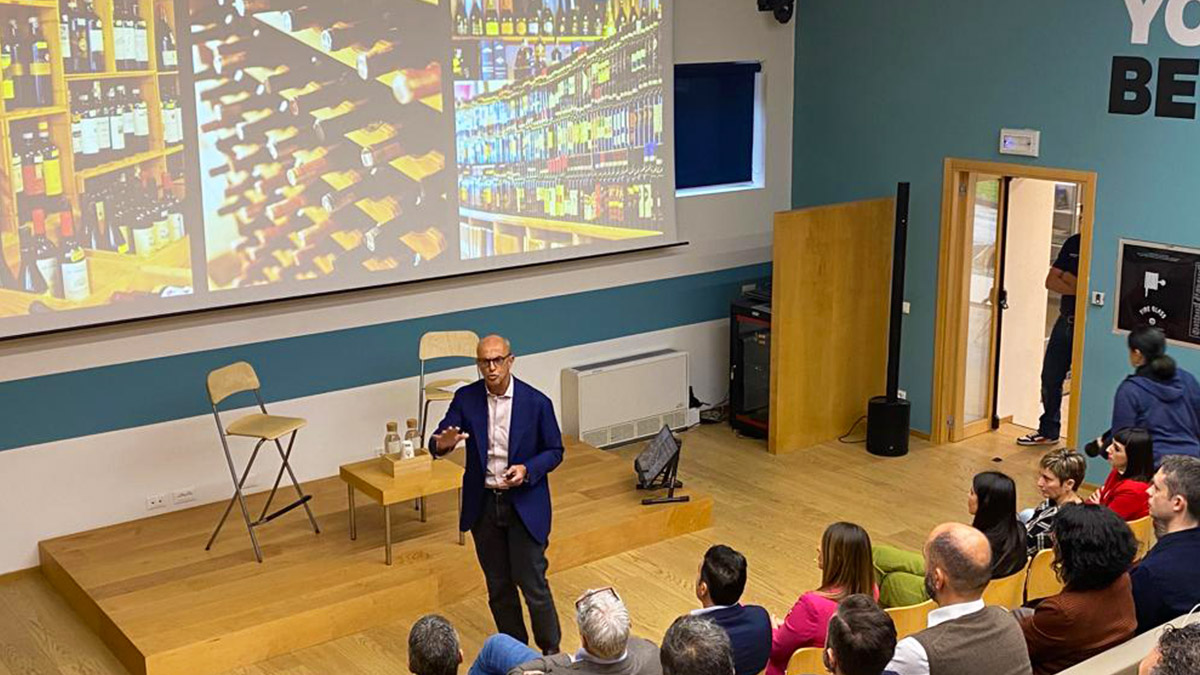
These guidelines served as the basis for the intervention that Fabrizio Bernasconi, founding partner of RBA Design and NABA lecturer, delivered at Dynamo Camp Onlus, as a guest of the Crealis Group.
A speech that highlights the value of design, particularly packaging design, in the world of Wine & Spirits.
An opportunity to share with industry experts RBA Design’s point of view on the value of packaging through a journey that involves a series of words that become guiding concepts in the development of new branding projects. This is an agency method that leads to analyzing not only WHAT is done, but also HOW and WHY (an aspect that is more distinct today than ever in choosing a branding partner) to create identities that are not only beautiful, but also right, have meaning, and ultimately help to sell.
And so what is the value of design in relation to packaging?
It is definitely the greatest means of contact with the consumer; there is a 100% interaction, it becomes a brand ambassador!
But is this value adequately recognized? A packaging design is often seen as a cost, while the investment and the return that can result from it are often significant.
Awareness about the value and effectiveness of design must first involve the agency, its attitude, and its method, ensuring that the designers themselves better understand the marketing processes and how their choices influence the customer’s decisions. This also means becoming partners with their clients by developing problem-solving logics that go beyond a just response to briefs. By becoming a visual business manager.
In this process, what Bernasconi considers to be the key words underlying a creative process come into play, particularly the creation of labels for the Wine & Spirits world. Labels that are able to tell stories, journeys between the past and the future.
Here are the 6 key words:
Authenticity. Perhaps it’s a mere word of advice, but certainly it marks a trend that will last over time. Building a brand means first of all knowing who you are. It means being authentic, beyond the concept of origin, which is so relevant in the food and beverage industry, but going beyond the concept of provenance to include the mission of a company, its distinctive characteristics and its raison d’être in the market. An example of this is the story of Cinzano, One of the oldest and most authentic brands, 100%italiano. A story that began in 1757, expressing all the know-how and Italian genius. A story that we have treated with care and respect, because we believe that only in their own authenticity can companies solidly build a brand narrative capable of standing the test of time.
Uniqueness. Among the various definitions of a brand, the one I prefer is the most concise: a brand is the difference, and therefore to brand oneself means first and foremost to create differences because a brand is established and strengthened primarily through recognition, identification, and visibility, followed certainly by meaning and sustainability. An example of this is the project Aperol 100 Y. Aperol is unique just like the 2 million labels, all different from each other, printed to celebrate the centenary of the famous Italian aperitif. A project where creativity and technology met to create innovation and support the brand values.
Flexibility/Adaptability. We always strive to put packaging at the center of a branding ecosystem. This involves equipping the brand, in its unmistakable visual assets, with a language that can adapt to different situations, allowing it to remain recognizable, even if different. In this regard, one project in which we have been involved for a long time and with great satisfaction regarding the design results achieved is the rebranding of AMARO AVERNA, which saw a deep work of packaging redesign and visual identity; a project aimed at making Amaro an Averna icon of lifestyle and culture of a new Sicily.
Accuracy. High-level details make the difference; if we want to communicate high quality through packaging, we need to pay attention to finishing, embossing, closing systems, and execution. Attention to detail and care must be part of every phase of the creative project. We almost go as far as saying that the attention to detail is more important in the design phase than in the execution; I’m thinking of researching new techniques and materials to give the pack and the product a greater perceived value. There are various cases that can arise from an agency like RBA design, which, through illustrations, finishing, special papers, and other materials, manages to give value and personality to label design. .
Simplicity. Packaging is often a good interpreter of lifestyles and needs. It represents the values of a period through its style; for example, we live in an environment dominated by uncertainty;
Consumers / people need to be reassured; they want clarity in their product choices (and the search for authenticity is a sign of this). Design translation lies in simplicity and essentiality; it is the right way to speak to consumers. It is important, once again, to find the signs that best characterize you, that make you recognizable.
Respect. We don’t know if talking about respect can also be about effectiveness, performance, sales (I think it can). Certainly we’re talking about responsibility and sustainability. In the case of wine, it certainly translates into respect for the environment. An emblematic case is that of , Fattoria La Maliosa with the creation of a label that tells the story of the method for cultivating and producing natural wines; a method that has been patented and is the company’s USP, on which to build; therefore, we decided to make the method an element of identity by describing it on the labels; a credible and authentic story of sustainability, starting from the territory, passing through experiences and reaching the bottle.
Here are the 6 key words of packaging: authenticity, uniqueness, accuracy, flexibility, simplicity and respect; to which we must add a seventh:
Digital. The present and the future (more and more) are also present in packaging through QR codes and other methods that help to tell stories, to deepen them, to create experiences; but let us also remember that
“Everything is digital, but not everything is digital”; we live in a hybrid world where digital and physical will always coexist and we will have to help each other (in the world of consumption) to support consumers’ expectations of buying not more products but stories, experiences, and solutions.