
Ideas, thoughts and reflections on the world of branding and packaging.
Needless to say, the last two years have been surprising and difficult for everyone. In the face of the enormity of the challenges we are facing, one question looms above all others: “What consequences will our actions have for the future?”
At RBA Design we believe that to work best it is necessary to understand the complexity of things: how problems are often generated by a multitude of interconnected causes; and that solutions are never univocal. For this reason, we thought of launching a series of events with you, small in-depth explorations into the issues that matter most to us, starting (ça va sans dire) with environmental sustainability. We hope they can open windows of knowledge necessary to start together on a common direction.
Not less but more!
Today's problems and the challenges of the future in the food packaging sector
Food waste is one of the most incomprehensible paradoxes of our time. Every minute, about eleven people die of hunger. Despite this, more than a third of the food produced globally each year is not consumed.
In addition to constituting an enormous economic and moral failure, food waste is responsible for over 6% of global greenhouse gas emissions, so much so that if food waste were a country, it would be the third most polluting country in the world. In Europe alone, it is estimated that approximately 100 million tons of food is wasted annually, a figure that is set to double in three decades.
In the sector in which RBA Design operates, that of food packaging, starting from this data is necessary to understand the objectives to be pursued in the near future. In Italy, eight out of ten people mistakenly believe that packaging materials are more harmful to the environment than food waste. If we listen to this erroneous perception, we could be driven to believe that the solution to be pursued is the “lesser of two evils”: reducing, shrinking, even trying to eliminate as many packaging as possible.
Packaging, on the other hand, must begin to be considered as an added value for reducing waste, rather than an additional environmental and economic cost. Much of the food waste is linked to the short shelf life of fresh products and misunderstandings regarding expiration dates. In this sense, packaging must be identified as an essential element to address the key challenge of sustainable food consumption.
Innovations in the food packaging sector can indeed improve gas and vapor exchanges with the external atmosphere, addressing the reduction of food waste and losses, preserving the quality of food, preventing chemical contamination of food and prolonging its shelf life. At the same time, of course, alternative solutions must be found that allow for reducing the accumulation of plastic waste and the consumption of petroleum (and we will discuss this in the near future).
For these reasons, the topic of sustainable packaging is gaining increasing interest among food companies. There are many companies that are working in this direction, investing in increasing the shelf life, reducing the weight of packaging, and using materials that are alternative to plastic. An exemplary example in this regard is Fattoria La Maliosa the agricultural company with which we have been working for many years.
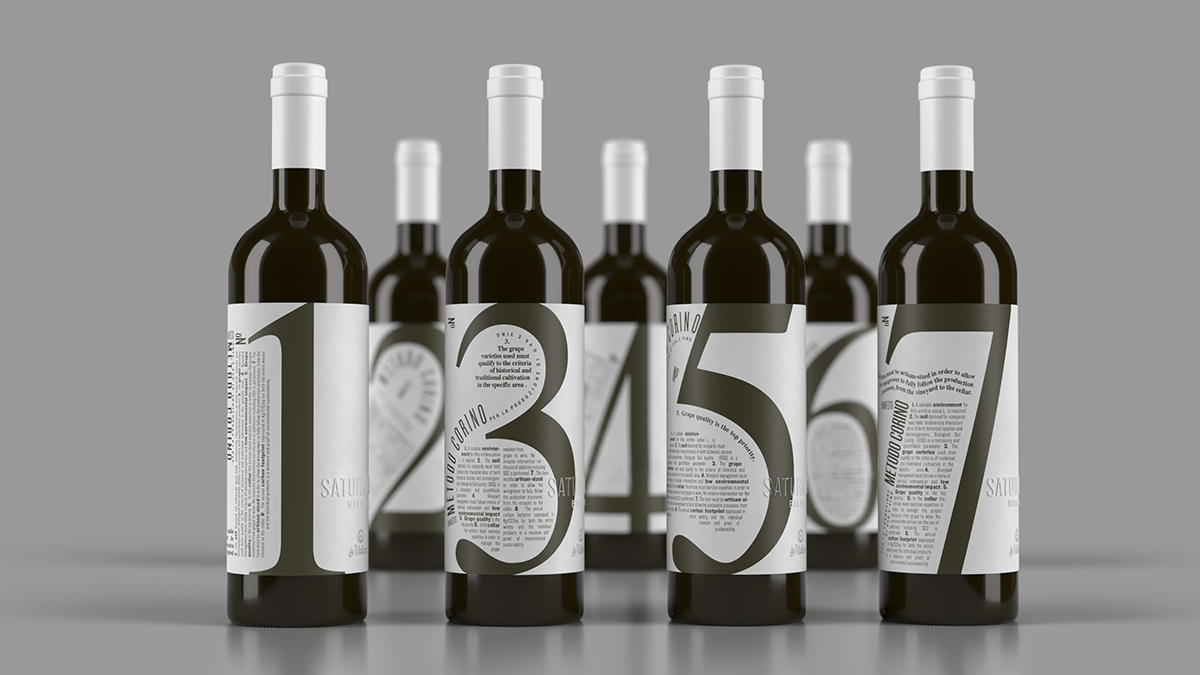
The talking label for Fattoria La Maliosa wins the bronze medal at Pentawards
A project of great interest that earned RBA Design the bronze medal at the Pentawards, the most important international award for the world of packaging design, in the ‘Sustainable Beverages’ category. This is the new design of the #Saturnalia red 2019 bottle by Fattoria La Maliosa. This recognition makes us very proud, as it rewards the bottle, characterized by a talking label that tells the MetodoCorino method used to produce the wines, through blockchain technology, allowing the consumer to quickly obtain all the information about the product, from cultivation to the passage into the winery. In the design of the Saturnalia wine label, the 8 principles of the Metodo are presented, with a modern and engaging layout, in as many multi-subject labels.
Creative Director: Nicola Mincione, Senior designer: Gianandrea Gregis, Designer: Margherita Niada.